Evidence-based guide · Updated October 2026
Types of ADHD: The 3 Official DSM-5 Presentations Explained
A quick search turns up '3 types,' '7 types,' even '12 types' of ADHD, and that split exists for a reason: only one of those numbers comes from the actual diagnostic manual. Here are the three clinically recognized presentations, what each looks like day to day, and honest context on where the bigger numbers actually come from.
Skip the reading: try our 8 free ADHD tools, no signup →
Table of Contents +
🎯 Quick Summary (TL;DR)
- Three official types: the DSM-5 recognizes exactly three ADHD presentations: predominantly inattentive, predominantly hyperactive-impulsive, and combined (NIMH).
- Combined is by far the most common: about 70% of patients, versus roughly 18.3% predominantly inattentive and 8.3% predominantly hyperactive-impulsive (StatPearls, Magnus et al., 2023).
- "7 types" isn't a diagnosis: that framework comes from Amen Clinics' brain SPECT imaging research, not the DSM-5. It's a proposed clinical model, not an official presentation category.
- ADHD and autism are separate but often overlap: both can be diagnosed in the same person, and each can make the other harder to spot.
- This page is educational, not diagnostic. A type based on a quiz or symptom list is a screening signal at best. An actual diagnosis takes a clinical evaluation.
The 3 Official Types of ADHD (DSM-5)
The National Institute of Mental Health names exactly three ADHD presentations, sorted by which symptom cluster dominates: predominantly inattentive, predominantly hyperactive-impulsive, and combined. MedlinePlus, the National Library of Medicine's consumer health site, confirms the same three-way split.
These aren't three separate conditions. They're one diagnosis, ADHD, described by whichever pattern of symptoms is strongest for that person right now, since a clinician also has to specify a presentation whenever ADHD is diagnosed.
Source: Magnus, Anilkumar, and Shaban, "Attention Deficit Hyperactivity Disorder," StatPearls (NCBI Bookshelf), last updated 2023. General patient population; not broken out by age group in the source.
In 2024, an estimated 7 million US children aged 3 to 17, or 11.7%, had a current ADHD diagnosis, based on a national parent survey (CDC). Among US adults, an estimated 15.5 million, or 6.0%, had a current diagnosis in late 2023 (Staley et al., 2024, MMWR). Every one of them fits into one of the three presentations below.
Predominantly Inattentive Type (What People Often Call ADD)
This presentation involves attention, organization, and follow-through problems without significant hyperactivity, and it's the type most often missed, especially in girls and women, because nothing about it disrupts a classroom or a meeting.
The CDC lists the core signs: missing details or making careless mistakes, trouble sustaining attention, seeming not to listen when spoken to directly, not following through on tasks, trouble organizing, avoiding tasks that need sustained mental effort, losing things needed for tasks, being easily distracted, and forgetfulness in daily activities. In practice, that can look like sitting perfectly still through an entire meeting while quietly missing half of what was said, or starting three loads of laundry and never moving any of them to the dryer. From the outside, this pattern usually just looks like daydreaming, spaciness, or being a little scattered, not a disorder.
This is also the presentation most closely tied to the old "ADD" label. Our guide to ADD vs ADHD covers why the term stuck around for decades after the diagnostic manual retired it, and our full guide to inattentive ADHD walks through the day to day signs, how common the presentation really is, and why it's so easy to overlook.
Predominantly Hyperactive-Impulsive Type
This presentation centers on physical restlessness and impulse control, with few or no significant attention problems. It's the presentation most people picture when they hear "ADHD," and it's also the one diagnosed least often on its own.
Classic signs, per the CDC, include fidgeting, difficulty staying seated, excessive talking, blurting out answers, interrupting, and trouble waiting a turn. In adults, this often looks different than it does in a hyperactive eight-year-old. The Attention Deficit Disorder Association (ADDA) describes adult hyperactivity as showing up more as inner restlessness, racing thoughts, or constant fidgeting than as the visibly disruptive behavior seen in children, so it can look like tapping a foot through a whole meeting or feeling wound up even while sitting quietly at a desk.
On its own, this presentation is the rarest of the three: the StatPearls figures cited above put it at roughly 8.3% of patients. Most people with meaningful hyperactive-impulsive symptoms also have significant inattention, which places them in the combined presentation instead.
Combined Presentation (the Most Common Diagnosis)
Combined type, a mix of both inattentive and hyperactive-impulsive symptoms, is by far the most frequently diagnosed presentation, in both clinical and school settings. CHADD and the ADDA both describe it as the most common and most treatable form of ADHD.
Presentation can also shift over a person's lifetime. The CDC states directly that "the way ADHD symptoms present may change over time." Picture a child who could not sit through dinner at age eight, all combined-type restlessness and blurted-out comments. By thirty, the fidgeting has mostly faded, but the same person still loses their keys weekly and rereads the same email three times before it lands. The outward hyperactivity settled. The inattentive core stayed. That's why an old childhood label is worth revisiting rather than assumed.
What About the "7 Types of ADHD"?
The "7 types of ADD" framework doesn't come from the DSM-5. It comes from Amen Clinics, founded by psychiatrist Daniel Amen, MD, who built the model from brain SPECT (single photon emission computed tomography) imaging patterns observed across hundreds of thousands of scans. It proposes named subtypes such as Classic, Inattentive, Overfocused, Temporal Lobe, Limbic, Ring of Fire, and Anxious ADD, each tied to a different brain-activity pattern on a scan.
That's a genuinely different kind of evidence than the DSM-5 uses, and it hasn't been adopted as a diagnostic standard. No major clinical guideline diagnoses a patient into one of these seven categories, and a SPECT scan is not part of a standard ADHD evaluation. Treat the seven-type model as a proposed framework worth discussing with a clinician if it interests you, not as a clinical alternative to the three official presentations.
| 3 official presentations (DSM-5) | 7 popular types (Amen Clinics) | |
|---|---|---|
| Basis | Reported behavior and history against DSM-5 criteria | Brain SPECT imaging patterns |
| Recognized diagnostic category? | Yes | No |
| Used by most clinicians for diagnosis? | Yes, this is the standard | No, a specialty framework |
| Requires a brain scan? | No | Yes, by design |
ADHD and Autism: Same Thing, Overlap, or Neither?
ADHD and autism spectrum disorder are distinct diagnoses in the DSM-5, and having one does not mean a person has the other. They do frequently co-occur, and both conditions can involve attention regulation and sensory sensitivities that make them easy to confuse.
How often they overlap depends heavily on who was studied, and published estimates vary widely. Our full comparison of ADHD and autism breaks down the differences, the shared traits, what having both (AuDHD) looks like, and why the overlap numbers disagree.
Given how much these two conditions can look alike from the outside, sorting out which one (or both) is present is a job for a qualified clinician doing a full evaluation, not something to settle from a symptom list alone.
How ADHD Types Are Diagnosed
A presentation is assigned through a clinical evaluation against DSM-5 criteria, not from a quiz or a symptom checklist filled out alone. Per the DSM-5 criteria table published by SAMHSA, children need six or more symptoms from either the inattention or hyperactive-impulsive list, and people 17 and older need five or more, with symptoms present for at least six months, showing up before age 12, and appearing in more than one setting, such as home and school or home and work.
Free online quizzes, including ones this site links to elsewhere, are a screening signal at best. They can suggest whether a fuller evaluation is worth pursuing. They cannot diagnose ADHD, rule out another condition, or tell you which presentation you have.
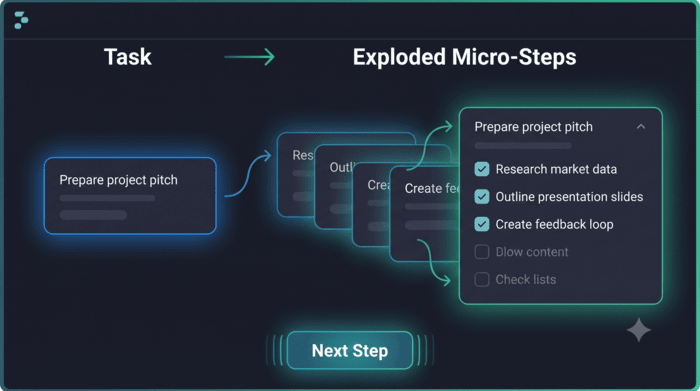
None of that changes what's useful today. Whichever presentation turns out to fit, or even before you've had it confirmed, the day to day friction points, task paralysis, time blindness, forgetfulness, are the same ones our guide to free ADHD focus tools is built around.
Presentations can look different by gender, which is one reason many women are diagnosed late. If you are thinking about getting evaluated, our guide to getting an ADHD diagnosis as a woman walks through the assessment process step by step.
If you are watching a child rather than yourself, see our guide to the signs of ADHD in kids, which breaks down what these presentations look like at different ages.
The Takeaway
- The DSM-5 recognizes exactly three ADHD presentations: predominantly inattentive, predominantly hyperactive-impulsive, and combined.
- Combined presentation is by far the most common, at roughly 70% of patients.
- The popular "7 types of ADHD" framework comes from Amen Clinics' brain-imaging research, not the DSM-5, and isn't a recognized diagnostic category.
- ADHD and autism are separate diagnoses that often co-occur, and only a clinical evaluation can sort out which is present.
Whichever presentation ends up fitting, start with the struggle that's costing you the most today. Read our deep dive on inattentive ADHD, see why the old ADD label stuck around, or browse the full free ADHD toolkit.
Frequently Asked Questions
What are some physical signs of ADHD?
Physical signs belong mostly to the hyperactive-impulsive side of ADHD: fidgeting, squirming, trouble staying seated, and restlessness. The CDC lists these alongside excessive talking and difficulty waiting a turn. In adults, the same restlessness often shows up more quietly, as an inner sense of being keyed up rather than visible fidgeting (ADDA). The predominantly inattentive presentation rarely produces these outward signs at all, which is a big reason it gets missed.
What are the differences between hyperactive and inattentive ADHD?
Predominantly hyperactive-impulsive ADHD centers on restlessness, impulsivity, and difficulty waiting or staying still, with fewer attention problems. Predominantly inattentive ADHD centers on distractibility, disorganization, and forgetfulness, without significant hyperactivity. Someone can also have both at once, which the DSM-5 calls the combined presentation, the pattern most people are actually diagnosed with.
Is ADHD a type of autism?
No. ADHD and autism spectrum disorder are separate diagnoses in the DSM-5, and having one does not mean a person has the other. They do frequently co-occur: a 2024 review in Frontiers in Psychiatry found that roughly 13% of children diagnosed with ADHD are eventually also diagnosed with autism, while comorbid ADHD in children with autism ranges from about 40% to 70% depending on the study (Martinez, Stoyanov, and Carcache, 2024). Only a qualified clinician can sort out which conditions are actually present.
Are there three or 7 types of ADHD?
The DSM-5, the manual clinicians use to diagnose ADHD, recognizes exactly three presentations: predominantly inattentive, predominantly hyperactive-impulsive, and combined. The '7 types' framework comes from Amen Clinics, built on brain SPECT imaging research by psychiatrist Daniel Amen, MD. It is a proposed clinical model, not a DSM-5 diagnostic category, so a professional evaluation for ADHD is based on the three official presentations, not the seven-type framework.
What is the rarest ADHD type?
Predominantly hyperactive-impulsive is the least common presentation on its own. A StatPearls review of ADHD epidemiology put it at about 8.3% of patients, compared with roughly 18.3% predominantly inattentive and about 70% combined presentation (Magnus, Anilkumar, and Shaban, 2023). Hyperactive-impulsive symptoms show up far more often blended into the combined presentation than they do in isolation.
Whichever Type Fits, Start With What's Hardest Today
ZeroLoginFocus is free, private, and works instantly in your browser. No signup, no email, no data leaving your device. Pick the tool that matches the struggle costing you the most right now.