Parent guide · Sourced to CDC and NIMH
Signs of ADHD in Kids: What Parents Should Actually Watch For
Every kid interrupts, forgets homework, and loses a jacket sometimes. ADHD is about degree, persistence, and whether it happens in more than one place, not about any single behavior. Here are the real signs of ADHD in kids, how they look at different ages, what else can mimic them, and what to do next.
Skip the reading: try our 8 free ADHD tools, no signup →
Table of Contents +
🎯 Quick Summary (TL;DR)
- Three patterns: ADHD signs in kids cluster into inattentive, hyperactive-impulsive, and combined presentations (CDC).
- It is common: the CDC estimates 7 million US children aged 3 to 17 (11.7%) had a current ADHD diagnosis in 2024, and boys were diagnosed more often than girls, 13% versus 7% (2022 to 2023).
- Persistence beats any single behavior: for children up to 16, clinicians look for at least six symptoms lasting 6 months or more, starting before age 12, in two or more settings (NIMH).
- Age changes what it looks like: a preschooler's signs, a first grader's signs, and a teenager's signs differ, so compare your child with other kids the same age.
- This page is educational, not diagnostic. If several signs sound familiar, the next step is a pediatrician, not a home quiz.
The 3 Patterns of ADHD Signs in Kids
ADHD, short for attention-deficit/hyperactivity disorder, is a neurodevelopmental condition whose signs start in childhood and often last into adulthood. The CDC sorts those signs into three presentations, depending on which symptoms are strongest. They are one diagnosis, not three separate conditions, and a child's pattern can shift over time.
🌫️ Inattentive
Hard to organize or finish a task, to pay attention to details, or to follow instructions. Easily distracted, and forgets details of daily routines.
⚡ Hyperactive-impulsive
Fidgets and talks a lot, finds it hard to sit still for long, interrupts others, and may have more accidents and injuries than other kids.
🔀 Combined
Symptoms of both types are equally present. The right label depends on what is strongest at the time of evaluation.
The inattentive pattern is the one parents and teachers miss most often, because a quiet, daydreaming child rarely disrupts a classroom. Our guide to inattentive ADHD explains why, and our breakdown of the 3 official types of ADHD covers how common each presentation is.
The CDC data also show a gap by sex: in 2022 to 2023, 13% of boys and 7% of girls had been diagnosed. That gap measures who gets diagnosed, not necessarily who has ADHD, and quieter inattentive signs in girls are one reason researchers think some are missed. If you are a parent wondering about your own history, see getting an ADHD diagnosis as a woman. For how the signs differ between girls and adult women, see our guide to ADHD symptoms in women.
Signs of ADHD in Kids by Age
The same checklist looks different at 4, 8, and 14, and what makes a behavior a sign is how far it sits from other children the same age. No source we found publishes a clean cutoff such as "a normal 5 year old can sit still for X minutes," so treat age as context for the questions below, not as a score.
| Age band | What parents often notice | Where an evaluation can start |
|---|---|---|
| 3 to 5 | Very short attention for activities, quickly switching, more talking and noise than same age peers, injuries from moving too fast (Kennedy Krieger) | Early intervention program under 3, school system at 3 or older, or a pediatrician (CDC) |
| 6 to 11 | Daydreaming, losing things, fidgeting, talking too much, trouble taking turns (CDC) | A pediatrician, with input from the teacher (AAP) |
| 12 to 17 | The same signs as demands rise, for example lost assignments and unfinished projects (CDC: symptoms can increase when demands rise) | A pediatrician or a mental health professional (CDC) |
Preschool (ages 3 to 5)
Dr. Mark Mahone, director of neuropsychology at the Kennedy Krieger Institute, lists ten signs in 3 and 4 year olds that are associated with an ADHD diagnosis once children reach school age. Among them: avoiding activities that need attention for more than a minute or two, losing interest and switching activities after a few moments, talking and making more noise than other children the same age, climbing on things after being told not to, being nearly always restless, getting into dangerous situations because of fearlessness, and being injured from moving too fast. This is one clinician's list of early risk signs, not a set of diagnostic criteria.
For children this young, evaluation routes differ. The CDC says a local early intervention program can evaluate a child under 3, and a school system can evaluate a child 3 or older, with no doctor's referral needed for early intervention. For ages 4 and 5, the CDC says behavior therapy, especially parent training, is recommended before medication is tried.
Elementary school (ages 6 to 11)
School adds long stretches of sitting, multistep instructions, and homework, and that is often where a mismatch with classmates first becomes visible. The CDC lists these signs in children: they daydream a lot, forget or lose things, squirm or fidget, talk too much, make careless mistakes or take unnecessary risks, have a hard time resisting temptation, have trouble taking turns, and have difficulty getting along with others. Teacher feedback carries real weight at this age: the American Academy of Pediatrics guideline for children aged 4 to 18 describes a partnership between families, doctors, and teachers, and notes that school staff often have a lot to contribute.
Tweens and teens (ages 12 to 17)
The CDC says the way ADHD presents may change over time, and that symptoms can increase when daily demands rise. For an older child, that tends to look like lost assignments, unfinished projects, and trouble organizing a multiday task, which are the same inattentive signs in a setting with fewer reminders. In national survey data, ADHD diagnoses are more common in the older band.
Source: Reuben and Elgaddal, "Attention-Deficit/Hyperactivity Disorder in Children Ages 5 to 17 Years: United States, 2020 to 2022," NCHS Data Brief No. 499, March 2024. National Health Interview Survey; a parent or guardian reported whether a doctor ever said the child had ADHD. Overall, 11.3%.
Read that chart with care. "Ever diagnosed" is a running total, so a 15 year old has had ten more years to be diagnosed than a 6 year old, and the older band also covers the years when school demands climb. The numbers show when diagnoses accumulate, not when symptoms begin. The sex difference in the same survey, 14.5% of boys versus 8.0% of girls, matches the CDC pattern above.
If your child's most visible trait is a tendency to zone out or stall on getting started, see ADD vs ADHD, which explains why the old "ADD" label still shows up in school conversations.
ADHD Symptoms in Kids: The Full List
Clinicians work from the DSM-5 criteria, which list nine inattention symptoms and nine hyperactivity and impulsivity symptoms (SAMHSA's reproduction of the criteria). For children up to 16, a diagnosis needs at least six symptoms from either list, or both (NIMH). Here are the two lists in plain language, framed as what a parent might see.
Inattention (9 symptoms)
- Misses details or makes careless mistakes in schoolwork
- Has trouble keeping attention on tasks or play
- Does not seem to listen when spoken to directly
- Does not follow through on instructions or finish chores and homework
- Has trouble organizing tasks and activities
- Avoids or dislikes tasks that need sustained mental effort
- Loses things needed for tasks, such as pencils, books, or a jacket
- Is easily distracted by unrelated sights and sounds
- Is forgetful in daily routines
Hyperactivity and impulsivity (9 symptoms)
- Fidgets, taps hands or feet, or squirms in the seat
- Leaves the seat when staying seated is expected
- Runs or climbs where it is not appropriate
- Cannot play or do leisure activities quietly
- Is "on the go," as if driven by a motor
- Talks excessively
- Blurts out an answer before the question is finished
- Has trouble waiting a turn
- Interrupts or intrudes on others
Most kids show some of these on a bad day, which is why the CDC states that occasional trouble focusing is normal in children. The count matters less than the pattern: how often, for how long, and whether it costs the child something at school, at home, or with friends.
The CDC data also show that ADHD rarely travels alone. Among US children aged 3 to 17 with current ADHD in 2022, 58.1% had moderate or severe ADHD and 77.9% had at least one other condition (Danielson et al., 2024, Journal of Clinical Child and Adolescent Psychology). The CDC summarizes this as almost half having a behavior or conduct problem and about 4 in 10 having anxiety. Those overlaps change how the signs look, and they are part of why the next section matters.
What Can Look Like ADHD but Isn't
Several ordinary problems produce the same behaviors, which is why a symptom list alone cannot settle the question. The NIMH says stress, sleep disorders, anxiety, depression, and other physical conditions can cause symptoms similar to ADHD. The CDC adds certain learning disabilities to that list.
- Hearing or vision problems: a child who "does not listen" may not hear well, and a child who avoids reading may not see the page clearly. The CDC says an evaluation includes hearing and vision tests for this reason.
- Sleep problems: a tired child can be fidgety, forgetful, and irritable, which reads as inattention and hyperactivity.
- Anxiety and depression: both can wreck concentration, and anxious kids can also look restless or irritable. They can also exist alongside ADHD, as the figures above show.
- Learning disabilities: a child who cannot yet read fluently may fidget, avoid homework, and lose focus because the task is too hard, not because attention is the root problem.
- Autism: a separate condition that often overlaps with ADHD. See ADHD and autism for how to tell them apart.
None of this means a child can't have ADHD. It means the evaluation has to look for the other explanations too, and sometimes finds more than one.
How ADHD in Kids Is Diagnosed and Treated
There is no single test for ADHD. The CDC says a diagnosis can come from a mental health professional such as a psychologist or psychiatrist, or from a primary care provider such as a pediatrician. The process includes a medical exam with hearing and vision tests, and reports from parents, teachers, and caregivers about behavior in different settings.
To meet the criteria, the NIMH says symptoms must begin before age 12, last at least 6 months, appear in two or more settings (for example at home, at school, or with friends), and interfere with social, school, or work functioning. Providers may also use rating scales and psychological tests to identify or rule out learning disabilities.
On treatment, the 2022 data show a split rather than a single path. Among children aged 3 to 17 with current ADHD, 53.6% received ADHD medication and 44.4% received behavioral treatment in the past year, while 30.1% received no ADHD specific treatment (Danielson et al., 2024). The CDC adds that about 32% received both.
Source: Danielson et al., "ADHD prevalence among U.S. children and adolescents in 2022," Journal of Clinical Child and Adolescent Psychology, 2024. 2022 National Survey of Children's Health (n=45,169). Medication and behavioral treatment overlap, so the bars do not sum to 100%.
The CDC's ADHD data page also notes that about 30% of children with ADHD received neither medication nor behavior treatment, up from 23% in 2016. If a child is struggling, that gap is worth knowing about. Specific medication and therapy choices are decisions for the child's clinician and family, not for a blog post.
Supporting a Child Who Shows These Signs at Home
You do not need to wait for an appointment to make daily friction smaller. Two kinds of friction come up most in the signs above: not knowing how much time is left, and not knowing where to start. Neither needs willpower to fix, and both can be made visible.
None of these tools is a treatment, and we are not aware of a study testing them. They are supports that fit alongside the behavior therapy and parent training the CDC describes. Our full guide to ADHD tools for kids walks through all four tools with step by step setups. Here are the two that map most directly to the signs on this page.
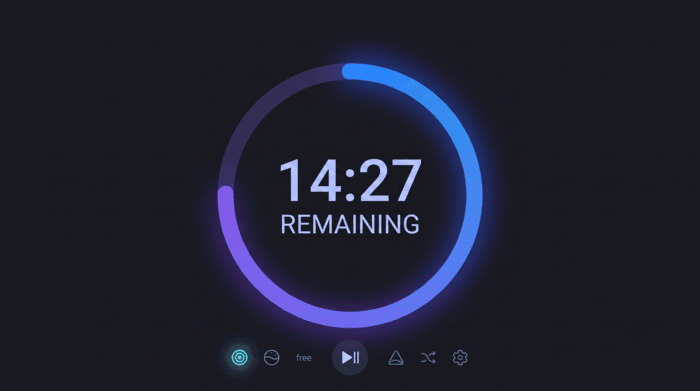
For "loses track of time" and "will not finish": the visual timer shows time as a shrinking ring instead of numbers. Try a 10 minute homework block followed by a 3 minute break, and say the plan out loud before starting.

For "does not follow through on instructions": OneStep splits a big task into small steps and shows one at a time, so "do your homework" becomes "open the math book to page 4." If you are building a wider toolkit for the family, our complete ADHD focus tools guide covers the adult version, and older kids who react very strongly to correction may find rejection sensitive dysphoria worth reading about.
The Takeaway
- ADHD signs in kids fall into three patterns: inattentive, hyperactive-impulsive, and combined.
- What counts is persistence: six or more symptoms for children up to 16, lasting 6 months, starting before 12, in two or more settings.
- The same behavior means different things at 4, 8, and 14, so compare your child with kids the same age.
- Sleep, hearing, vision, anxiety, and learning problems can mimic ADHD, and can also exist alongside it.
- Only a clinical evaluation can diagnose ADHD. A pediatrician is the right first call.
If several signs feel persistent, write down specific examples from home and school, and bring them to your pediatrician. In the meantime, the free, no signup supports in the section above are worth a try today.
Frequently Asked Questions
What are 5 signs a child may have ADHD?
The CDC lists several common signs in children: daydreaming a lot, forgetting or losing things, squirming or fidgeting, talking too much, and having trouble taking turns. Others on the CDC list include careless mistakes, taking unnecessary risks, and trouble getting along with others. Any one of these is ordinary for a child. What points toward ADHD is a cluster of them that keeps happening, in more than one setting, and gets in the way of school, home, or friendships.
What is the red flag of ADHD?
There is no single red flag, and that is the point. The NIMH diagnostic criteria ask whether symptoms have lasted at least 6 months, began before age 12, show up in two or more settings such as home and school, and interfere with social, school, or work functioning. A behavior that only happens in one place, or only for a few weeks, is a weaker signal than a pattern that follows the child everywhere.
At what age does ADHD start to show?
Symptoms must begin before age 12 to meet NIMH criteria, and the CDC says ADHD signs start in childhood. Some clinicians watch for earlier markers: Dr. Mark Mahone of the Kennedy Krieger Institute lists ten signs in 3 and 4 year olds that are associated with a later diagnosis. The American Academy of Pediatrics guideline covers children from age 4 to 18. Many children are diagnosed later, once school demands expose the pattern, so the age a child is diagnosed is not the age the signs began.
What are the signs of ADHD in a 6 year old child?
The CDC list applies at 6: daydreaming a lot, forgetting or losing things, squirming or fidgeting, talking too much, trouble taking turns, and difficulty getting along with others. The diagnostic threshold is also the same, six or more symptoms for children up to 16 (NIMH). The useful comparison at this age is with other 6 year olds, not with an older sibling. Feedback from the teacher matters because the American Academy of Pediatrics notes that school staff often have a lot to contribute.
What can be mistaken for ADHD in children?
The NIMH says stress, sleep disorders, anxiety, depression, and other physical conditions can cause similar symptoms. The CDC adds certain learning disabilities, and its evaluation steps include hearing and vision tests to rule out other problems. These conditions can also occur alongside ADHD, which is why a full evaluation matters more than a checklist.
What does an ADHD meltdown look like?
The Child Mind Institute describes a meltdown as a severe outburst in which the child loses control and it ends only when the child wears out or a parent calms them, unlike a milder tantrum where some control remains. Emotional outbursts are not among the listed ADHD symptoms, but they are common alongside it. The CDC reports that almost half of children with ADHD have a behavior or conduct problem, and about 4 in 10 have anxiety. A child who has frequent, severe meltdowns deserves an evaluation that looks at all of these.
Turn What You Noticed Into One Small Step Today
ZeroLoginFocus is free, private, and works instantly in your browser. No signup, no email. Start with the tools our guide to ADHD tools for kids covers, or open the visual timer and try a 10 minute homework block.