Evidence-based guide · Updated October 2026
Inattentive ADHD: Signs, Causes, and What Actually Helps
No hyperactivity, no disruption, no obvious red flag. Just a quiet pattern of missed details, lost items, and unfinished tasks that gets written off as a personality quirk instead of what it actually is: a real, well-documented presentation of ADHD. Here is what it looks like, why it gets missed for years, and what to do once you recognize it.
Skip ahead: try a free tool for task paralysis now →
Table of Contents +
🎯 Quick Summary (TL;DR)
- What it is: One of three DSM-5 ADHD presentations, marked by distractibility, forgetfulness, and disorganization with little or no hyperactivity. It's the modern name for what used to be called ADD.
- Is it rare? No. In a large field trial of 18 to 19 year olds, inattentive presentation was actually the most common single type, more common than combined or hyperactive/impulsive-only (Matte et al., Psychological Medicine, 2014).
- Why it's missed: It rarely disrupts a classroom or a meeting, so it reads as "daydreamer" or "unmotivated" instead of a medical presentation. Women are diagnosed roughly five years later than men on average, largely for this reason.
- What helps: There's no cure, but structured routines, therapy, medication under a prescriber's supervision, and free tools that offload working memory and time tracking all make it more manageable day to day.
What Is Inattentive ADHD?
Inattentive ADHD is one of three presentations of attention-deficit/hyperactivity disorder defined in the DSM-5, alongside hyperactive/impulsive and combined presentation. It's marked by chronic distractibility, forgetfulness, and disorganization, with few or no symptoms of hyperactivity or impulsivity. If the term "ADD" sounds more familiar, that's because it's the older name for essentially the same pattern: the DSM dropped the standalone "ADD" label decades ago and folded it into ADHD as the inattentive presentation. We trace the full ADD vs ADHD history in a separate guide.
That distinction matters because inattentive ADHD is a presentation of a single underlying disorder, not a separate condition. According to the Cleveland Clinic, it's a type of ADHD that affects focus and organization with little to no hyperactive symptoms, which is exactly why it looks so different from the version of ADHD most people picture: a fidgety kid who can't sit still. Someone with inattentive ADHD can sit perfectly still through an entire meeting while quietly missing half of what was said.
Clinically, the DSM-5 requires five or more inattentive symptoms for people age 17 and older, or six or more for children under 17, persisting for at least six months, present in two or more settings (home, school, work, or social situations), and clearly interfering with daily functioning. The CDC lays out these criteria as part of a full diagnostic evaluation, not a self-administered checklist, which is worth keeping in mind as you read the signs below.
The National Institute of Mental Health describes ADHD broadly as a developmental disorder marked by persistent symptoms of inattention, hyperactivity, and impulsivity. Inattentive presentation is what it looks like when the inattention symptoms are doing nearly all the work and the hyperactivity and impulsivity symptoms barely show up at all.
The Signs: What Inattentive ADHD Looks Like Day to Day
The individual signs sound small on their own. What makes them add up to inattentive ADHD is how consistently they show up together, across settings, for years, not just during a stressful month.
Attention drifts
Careless mistakes from missed details, trouble sustaining focus through a lecture, meeting, or long conversation, and difficulty following instructions through to the end.
Things go missing
Losing everyday essentials like keys, phones, and paperwork, and keeping workspaces, backpacks, or living spaces that stay chronically disorganized no matter how many times you clean them.
Follow-through stalls
Starting projects with real intention and then not finishing them, and forgetting appointments, chores, or returning calls, even ones you genuinely meant to handle.
These six patterns, missed details, poor sustained focus, weak follow-through, misplaced items, chronic disorganization, and forgetfulness, form the consistent core described across clinical sources. The Cleveland Clinic and the Child Mind Institute both describe this same cluster, and both are explicit about what's absent: no hyperactive fidgeting, no impulsive blurting, no classroom disruption to flag the problem to a teacher or manager.
None of these signs are unusual in isolation. Everyone loses their keys occasionally. What separates inattentive ADHD from an off week is frequency, duration, and the fact that the pattern shows up in more than one part of your life at once, not just when you're tired or stressed.
This drifting pattern is close to the functional opposite of ADHD hyperfixation, where attention locks onto one thing and won't let go. Many people with inattentive ADHD experience both: unable to hold focus on the task in front of them, then unable to disengage from something else entirely, sometimes on the same day.
How Common Is Each ADHD Presentation?
Inattentive ADHD is not the rare or unusual type. Among young adults, it's actually the most common single presentation, more common than combined presentation and far more common than hyperactive/impulsive presentation on its own.
Source: Matte et al., "ADHD in DSM-5: a field trial in a large, representative sample of 18- to 19-year-old adults," Psychological Medicine, 2014 (n=4,000, 1993 Pelotas Birth Cohort Study). Overall DSM-5 ADHD prevalence in this sample was 3.55%.
A 2014 field trial published in Psychological Medicine evaluated 4,000 young adults from Brazil's 1993 Pelotas Birth Cohort Study using an instrument covering the full DSM-5 criteria. It found inattentive-only presentation in 1.65% of the sample, combined presentation in 1.45%, and hyperactive/impulsive-only presentation in just 0.45%, for an overall DSM-5 ADHD prevalence of 3.55% (Matte et al., 2014). Read that carefully and the popular assumption flips: hyperactive/impulsive-only is the rarest presentation at this age, not inattentive.
Zoom out to adults generally and the picture stays consistent on scale, if not on presentation breakdown. A 2021 global systematic review and meta-analysis estimated that persistent adult ADHD affects 2.58% of adults worldwide, translating to roughly 139.84 million people in 2020 (Song et al., Journal of Global Health, 2021). That's not a niche condition. It's a large, underrecognized population, and inattentive presentation is a meaningful share of it.
Why Inattentive ADHD Gets Missed
Inattentive ADHD rarely disrupts a classroom or a workplace, so instead of getting flagged as a possible medical presentation, it gets labeled a personality trait: "daydreamer," "spacey," "just needs to try harder." According to the Child Mind Institute, symptoms often become most obvious during major life transitions, middle school, college, or a first job, when organizational demands finally outpace whatever coping strategies a person built without realizing they were compensating for anything.
There's also a structural reason the presentation flies under the radar: much of the foundational DSM research on ADHD was validated on samples skewed toward hyperactive-presenting boys, the group whose symptoms are hardest to ignore in a classroom. That historical skew shaped which behaviors clinicians, teachers, and parents were trained to recognize as "ADHD," and inattentive symptoms simply weren't part of the pattern most people were looking for.
The result is a presentation that can go unnamed for a decade or more, not because it's mild, but because it's quiet. Someone can meet every clinical criterion for inattentive ADHD and never once get sent to a school counselor or flagged by a manager, because nothing about the presentation looks urgent from the outside.
Inattentive ADHD in Women and Girls
This presentation is a major driver of the well-documented ADHD gender diagnosis gap, because its symptoms are exactly the ones most easily masked or misread as something else. Girls and women more often display inattentive symptoms, forgetfulness, trouble focusing, disorganization, while boys and men more often display the hyperactive and impulsive symptoms that are simply easier for parents and teachers to notice (CHADD).
Women are diagnosed with ADHD roughly five years later than men on average, despite symptoms appearing at a comparable age (Psychiatric Times). Part of that delay comes from masking: girls learn compensatory behaviors early, over-preparing, copying peers' organizational habits, staying quiet, that hide the underlying pattern from view even while it costs real effort to maintain. Part of it comes from misattribution: a girl or woman who presents with inattention often gets treated for anxiety or depression instead, since those diagnoses fit the visible distress without anyone asking whether an underlying attention presentation is driving it.
The consequence of a five-year (or longer) delay isn't neutral. Years spent internalizing "why can't I just get it together like everyone else" as a character flaw, rather than a medical presentation with a name, tend to leave a mark on self-esteem long after a late diagnosis finally explains what was happening.
If this sounds familiar and you are considering an evaluation, our guide to getting an ADHD diagnosis as a woman explains what the assessment involves and how to prepare.
Inattentive ADHD in Adults vs. Kids
The underlying deficits stay largely the same from childhood into adulthood. What changes is the demands that expose them. A child with inattentive ADHD loses homework and daydreams through class; an adult with the same presentation misses deadlines, forgets bills, and loses track of a Slack thread mid-project. Same pattern, different stakes.
Estimated prevalence of persistent adult ADHD
Source: Song et al., "The prevalence of adult attention-deficit hyperactivity disorder: A global systematic review and meta-analysis," Journal of Global Health, 2021. Adjusted for global demographic structure in 2020.
The 2021 global meta-analysis that estimated 2.58% overall adult prevalence also broke that figure down by age band, and the decline is steep: from an adjusted 5.05% among 18 to 24 year olds down to 0.77% among adults 60 and older (Song et al., 2021). Some of that drop reflects genuine symptom reduction with age. But researchers studying the topic also point to a diagnostic-cohort effect: many older adults with inattentive ADHD were never evaluated as kids, because the presentation was quiet enough to go unnoticed through an entire childhood and adolescence in an era when awareness of the inattentive type was even lower than it is now. Some of that curve is biology. Some of it is decades of missed referrals finally catching up with the data.
That's part of why adult diagnosis in your 30s or 40s isn't unusual, and it's not a sign the presentation was ever mild. It's often a sign nobody was looking for it at the age when hyperactivity, not quiet inattention, was what triggered an evaluation. If you're trying to understand how the same pattern shows up in a child, our guide to ADHD tools for kids covers the classroom and homework-specific version of this. For the signs parents and teachers can watch for by age, see our guide to the signs of ADHD in kids.
Is It Something Else? Ruling Out Look-Alikes
Inattentive ADHD overlaps in appearance with several other conditions, which is part of why "is inattentive ADHD autism" is one of the most common related searches on this topic. Getting the pattern right matters, because the right next step depends on it.
- Autism spectrum disorder: A distinct condition with its own diagnostic criteria, though co-occurrence with ADHD is common. A review in Frontiers in Human Neuroscience found that an estimated 22 to 83% of autistic children also meet ADHD criteria, and 30 to 65% of children with ADHD show clinically significant autistic traits (Frontiers in Human Neuroscience, 2014). The wide range reflects differing study methods, but the overlap itself is well established. Our side-by-side guide covers how ADHD and autism differ.
- Anxiety and depression: Both can cause distraction, but the mechanism differs. Anxiety-driven distraction tends to center on a specific worry; depressive low motivation tends to come with flattened interest across the board. Inattentive ADHD's distractibility is more chronic and less tied to a single emotional trigger, though all three can and do co-occur.
- Sleep disorders: Chronic poor sleep produces attention and memory problems that closely mimic inattentive ADHD. A clinician ruling out a sleep disorder before or alongside an ADHD evaluation is standard practice, not an unnecessary extra step.
None of this is a self-diagnosis tool. If a pattern like this is affecting your work, relationships, or daily functioning, a clinician who can evaluate the full picture, not a symptom list on a blog post, is the right way to sort out which explanation actually fits.
What Actually Helps
There's no cure for inattentive ADHD, because it's a lifelong neurodevelopmental presentation, not a temporary problem to solve once. The realistic target is management, and a few categories come up repeatedly across clinical sources: behavioral therapy, medication under a prescriber's supervision, structural routines, and external tools that offload the exact deficits involved.
That last category is where most people can start today, with no appointment and no waitlist. Each inattentive-type deficit has a fairly specific, low-friction intervention that clinicians already recommend in some form, just usually without a free tool built for it. If you want to compare paid apps as well, see our list of ADHD apps for adults, sorted by problem:
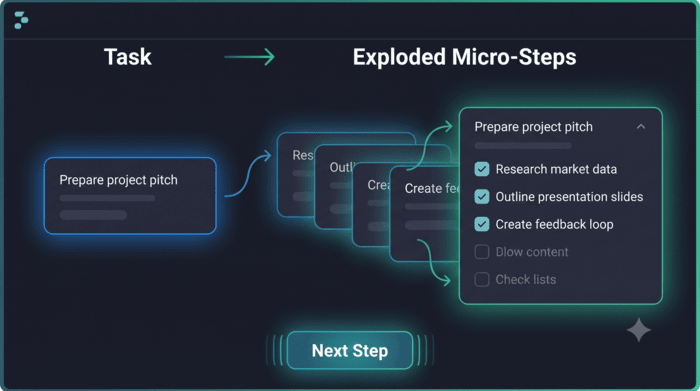
🧩 Task initiation stalls
OneStep breaks an overwhelming task into micro-steps small enough that starting doesn't require a burst of willpower you may not have available.
⏱️ Time blindness
TimeBlind replaces an abstract clock with a shrinking visual arc, making elapsed time something you can actually see instead of estimate.
🧠 Working memory overload
BrainYap records up to two minutes of speech and sorts it into tasks, ideas, and reminders, so a stray thought doesn't have to be held in your head until you can act on it.
📱 Distraction and drift
FocusWall turns every new browser tab into a display of your single current task, closing the small gap where attention usually wanders off.
None of these tools are a substitute for a clinical evaluation, medication if a prescriber recommends it, or therapy if that's what helps. They're the piece you can act on right now, today, while a diagnosis or a treatment plan is still in progress or a waitlist away. For the full lineup, see our guide to all 8 free ADHD focus tools, all of them no-signup and private by default.
If the emotional side of ADHD, the frustration, the shame spiral after another missed deadline, feels like the bigger obstacle some days, that's a documented pattern too. Our guide to rejection sensitive dysphoria in ADHD covers it, and it pairs with the same "build the plan before you need it" approach that makes these tools useful in the first place.
The Takeaway
Inattentive ADHD doesn't look like the version of ADHD most people picture, and that's exactly why it takes so long for so many people to get a name for it. It's not rare, it's not mild, and it's not a personality flaw. It's a well-documented presentation with real diagnostic criteria, real prevalence data behind it, and real, specific ways to manage it once you know what you're looking at.
You don't need a diagnosis to start addressing the piece that's costing you the most right now. Try OneStep on your next stalled task, or explore the full toolkit, and start with whichever deficit is hitting hardest today.
Frequently Asked Questions
Is inattentive ADHD autism?
No. They are distinct conditions with different diagnostic criteria, though they commonly co-occur. Research reviewed in Frontiers in Human Neuroscience found that an estimated 22 to 83% of autistic children also meet criteria for ADHD, and 30 to 65% of children with ADHD show clinically significant autistic traits. The wide ranges reflect differences in study methods and populations, but the direction is consistent: overlap is common, and one diagnosis does not rule out the other.
What is the rarest ADHD type?
Among 18 to 19 year olds evaluated in a large Brazilian birth-cohort field trial, the hyperactive/impulsive-only presentation was the rarest, at an estimated 0.45% of the sample, compared with 1.65% for inattentive-only and 1.45% for combined presentation (Matte et al., Psychological Medicine, 2014). By that data, inattentive is actually the most common single presentation at this age, not the rarest, which runs against the popular assumption that inattentive ADHD is unusual.
What are inattentive ADHD people good at?
Clinical sources describe strengths that often travel with this presentation: the ability to hyperfocus on genuinely interesting problems, creative and nonlinear thinking, and pattern recognition across seemingly unrelated ideas. These are not universal traits and they do not offset the functional cost of the deficits, but they are consistently reported alongside the difficulties, not instead of them.
How serious is inattentive ADHD?
Left unmanaged, it can meaningfully affect work performance, relationships, and self-esteem, especially because it is so often misread as a character flaw rather than a medical presentation. The Child Mind Institute notes that difficulty with attention, forgetfulness, and executive functioning can create real academic and occupational struggles even without any hyperactive behavior to signal a problem. Severity varies widely by person, which is part of why a clinical evaluation, not a symptom checklist, is the right way to gauge it.
What medications are commonly used to treat inattentive ADHD?
Clinical sources describe two broad drug classes for ADHD generally: stimulants (such as methylphenidate and amphetamine-based medications) and non-stimulants (such as atomoxetine and certain alpha-agonists). This is informational only. Response varies by individual, and any medication decision should be made with a prescriber who can evaluate your specific history. Nothing here is a recommendation to start, stop, or change a medication on your own.
What does ADHD burnout feel like?
A state of depleted executive function where even small tasks feel impossible, often following a stretch of compensating hard for undiagnosed or unmanaged symptoms. It overlaps with the emotional dysregulation covered in our guide to rejection sensitive dysphoria in ADHD. A pre-planned recovery routine, built before the burnout hits, tends to help more than trying to problem-solve in the middle of it.
Start With the Tool That Matches Your Biggest Struggle
ZeroLoginFocus is free, private, and works instantly in your browser. No signup, no email, no data leaving your device. Pick the tool that addresses your specific inattentive-type deficit and try it right now.