Evidence-based guide · Updated October 2026
ADHD Burnout: Signs, the Cycle, and How to Recover
You take the weekend off, sleep in, do nothing, and Monday still feels impossible. That is the exhaustion people mean by ADHD burnout, and most burnout advice misses it because it assumes you just need rest. ADHD burnout builds from a different source: years of working overtime to compensate for how your brain handles time, planning, and attention. Here is what it is (and what it is not), the signs, the cycle that keeps it coming back, what the research says causes it, and a recovery plan that starts by taking things off your plate.
Skip ahead: the step by step recovery plan →
Table of Contents +
🎯 Quick Summary (TL;DR)
- What it is: ADHD burnout is deep physical, mental, and emotional exhaustion that builds up from constantly compensating for ADHD. It is not an official diagnosis, but the pattern behind it is well documented
- What drives it: in a 2024 study of 171 employees, people with ADHD scored far higher on burnout. The gap ran through two executive function problems: managing time and staying organized (Turjeman-Levi et al., AIMS Public Health)
- Masking adds to the bill: in a 2025 study of 1,056 neurodivergent young adults, 83% scored high on masking at school or work, but only 21% did around other neurodivergent people (Wurth et al., Frontiers in Psychiatry)
- How to recover: subtract before you add. Cut demands first, then rebuild with outside supports for time and planning instead of a new productivity system
- When to get help: if low mood lasts most days for two weeks or more, or you think about harming yourself, talk to a doctor. In the US, call or text 988
What Is ADHD Burnout?
ADHD burnout is a state of physical, mental, and emotional exhaustion that builds up from the ongoing effort of compensating for ADHD symptoms. It is the tiredness of spending years using extra effort, reminders, adrenaline, and willpower to do what other people seem to do on autopilot. Eventually, the reserves that effort ran on are gone.
One thing most guides skip: "ADHD burnout" is not a diagnosis. You will not find it in the DSM-5 or in the World Health Organization's ICD-11. Even plain burnout is not classified as a medical condition. The WHO lists burn-out in ICD-11 as an "occupational phenomenon." It defines burn-out as "a syndrome conceptualized as resulting from chronic workplace stress that has not been successfully managed." That syndrome has three dimensions: energy depletion or exhaustion, mental distance or cynicism about your job, and reduced professional efficacy. The WHO also says the term should not be applied to other areas of life.
So why use the label at all? Because the experience does not respect that boundary. ADHD affects how you handle bills, laundry, relationships, and appointments just as much as deadlines at work, so the compensation effort, and the exhaustion that follows it, runs across your whole life. "ADHD burnout" is a useful name for that pattern. Treat it as a description that helps you spot what is happening, not as a diagnosis that explains everything.
ADHD Burnout Symptoms: What It Feels Like
The core signs of ADHD burnout are exhaustion that sleep does not fix, tasks that used to be manageable suddenly feeling impossible to start, and a much shorter emotional fuse. People in ADHD communities describe it less as being tired and more as running on empty: the systems and workarounds that used to hold life together stop working all at once.
Mental exhaustion is close to universal among neurodivergent adults. In a 2025 study of 1,056 Norwegian young adults with ADHD, autism, or both, 94% named "mental exhaustion" as one of their challenges. No other item on the list was chosen more often (Wurth, Fuermaier, Strand & Thorell, Frontiers in Psychiatry, 2025).
Physical signs
- Fatigue that a full night's sleep or a weekend off does not touch
- Headaches, tension, or getting sick more often
- Sleep that swings between too little and too much
Cognitive signs
- Heavy brain fog and decision fatigue over small choices
- ADHD shutdown: freezing in front of a task you know how to do
- Routines that used to run on autopilot quietly falling apart
Emotional signs
- Irritability and snapping at small things
- Shame about falling behind, and avoiding messages because of it
- Losing interest in hobbies and people you usually enjoy
Criticism also tends to land harder when you are depleted. If a small comment can knock you flat for the rest of the day, read our guide to rejection sensitive dysphoria. Rejection sensitivity gets louder when your reserves are low, and the two often feed each other.
The ADHD Burnout Cycle
ADHD burnout usually is not a single event. It runs as a loop: a productive burst, overcommitment, a crash, shame about the crash, and a push to catch up that starts the next burst. The Attention Deficit Disorder Association (ADDA) describes the same cycle of intense effort followed by exhaustion. It is a widely used clinical description rather than a formally tested model, but most people with ADHD recognize it immediately.
Diagram: ZeroLoginFocus, based on the burnout cycle described by the Attention Deficit Disorder Association (2024). A descriptive model, not a validated clinical scale.
- Boom: a deadline, a new project, or a stretch of hyperfocus gives you a surge of energy. This is the same pull described in our guide to the hyperfocus boom before the crash.
- Overcommit: it finally feels like you are on top of things, so you say yes to more.
- Crash: the energy runs out while the commitments stay, and everything stalls at once.
- Shame: you read the crash as a character flaw, and start hiding it.
- Catch-up: you push harder with adrenaline and all-nighters to make up the lost ground, which sets up the next boom.
The key detail is where the loop can break. The instinct after a crash is to catch up, which is exactly the move that restarts the cycle. The exit is to cut demands at the crash point instead, which is what the recovery plan below is built around.
Why ADHD Brains Burn Out: What the Research Shows
The strongest evidence points to two drivers: the constant strain on executive function, and the effort of masking ADHD traits to fit in. Neither is about laziness or weak willpower. Both are about how much extra work it takes to run a normal day.
Executive function strain
A 2024 study of 171 employees, 38 with ADHD and 133 without, measured both burnout and everyday executive function. Employees with ADHD scored much higher on burnout (a mean of 5.05 versus 3.76 on a 1 to 7 scale), a large difference by research standards (Cohen's d = 1.13). They also reported more executive function difficulties (2.65 versus 1.92 on a 1 to 4 scale) (Turjeman-Levi, Itzchakov & Engel-Yeger, AIMS Public Health, 2024).
Source: Turjeman-Levi, Itzchakov & Engel-Yeger, AIMS Public Health, 2024 (n=171). Column height shows each mean as a share of its scale maximum.
The more useful finding is how the gap worked. Executive function difficulties explained the link between ADHD and burnout, and different difficulties explained different kinds of exhaustion. Trouble managing time accounted for the physical fatigue. Trouble with organizing and problem solving accounted for the emotional exhaustion and the cognitive weariness. In plain terms: if your burnout feels mostly physical, look first at how your days overrun. If it feels mostly mental and emotional, look first at how much planning you are carrying in your head. The prevention section below turns this into a simple map.
Other studies point the same way. Among 751 Brazilian university students, inattention scores were significantly correlated with emotional exhaustion and with depersonalization (Porto, Murgo & Souza, Paidéia, 2024). Depersonalization is the detached, going through the motions feeling that burnout scales measure. An older Swedish study looked at 62 adults on long-term sick leave for burnout. It judged 24% to have ADHD, rising to 56% when suspected cases were included (Brattberg, Stress and Health, 2006). That sample is small and the study is 20 years old, so treat it as a signal worth taking seriously, not a prevalence figure.
Part of the reason this compensation runs so long is that many adults do not know they have ADHD. According to CDC/NCHS Data Brief No. 543 (December 2025), 55.9% of the roughly 15.5 million US adults with an ADHD diagnosis were first diagnosed at 18 or older. That is years or decades of working around symptoms without a name for them.
You will also see the claim that adults with ADHD burn out at "three to six times" the rate of other adults. We could not find a primary study behind that number, so we have left it out.
The cost of masking
Masking means hiding or compensating for ADHD traits to appear "on top of things": overpreparing, rehearsing conversations, suppressing fidgeting, double checking everything. In a study of social camouflaging published by Simon Fraser University researchers in June 2026, more than 91% of 202 adults with ADHD masked their traits to some extent. Some participants said they needed days to recover after periods of intense masking (Medical Xpress, June 8, 2026).
Masking is not constant, though, and that matters for recovery. In the 2025 Norwegian study, the share of participants scoring 4.0 or higher on the masking scale dropped sharply depending on who they were with.
Source: Wurth, Fuermaier, Strand & Thorell, Frontiers in Psychiatry, October 2025 (n=1,056 Norwegian young adults aged 18 to 35 with ADHD, autism, or both).
The same study found masking was linked to lower quality of life in every setting. The practical upshot: masking is heaviest exactly where most people spend their week, and lightest around people who get it. That gap is something you can use on purpose while you recover. Women in particular are more likely to have spent years masking, which is covered in our guide to masking and ADHD symptoms in women.
ADHD Burnout vs Depression vs Autistic Burnout
These three overlap and can happen at the same time, but they are not the same thing. Burnout usually eases when demands genuinely drop. Depression tends to stay regardless and is a diagnosable condition that needs treatment. Autistic burnout, the one of the three with a published research definition, adds loss of skills and lower tolerance for sensory input.
| ADHD burnout | Depression | Autistic burnout | |
|---|---|---|---|
| Official status | Descriptive term, not a diagnosis | Diagnosable mood disorder | Defined in research, not a diagnosis |
| Core feature | Exhaustion from compensating for ADHD | Persistent low mood or loss of interest | Exhaustion, loss of function, reduced tolerance to stimulus |
| Typical duration | No research timeline | Symptoms most of the day, nearly every day, for at least 2 weeks | Typically 3 months or more |
| Usually eases with | Fewer demands, outside supports, less masking | Professional treatment (therapy, medication) | Rest, fewer demands, lower sensory load, support |
Sources: WHO ICD-11 (2019); National Institute of Mental Health; Raymaker et al., Autism in Adulthood, 2020.
The autistic burnout definition comes from a 2020 study run by autistic and non-autistic researchers together. It describes autistic burnout as "pervasive, long-term (typically 3+ months) exhaustion, loss of function, and reduced tolerance to stimulus." The researchers trace it to chronic life stress and a mismatch between expectations and abilities without adequate support (Raymaker et al., Autism in Adulthood, 2020). People who are both autistic and ADHD (often called AuDHD) can experience both kinds, and it helps to know which pattern you are in. Our guide to how ADHD and autism overlap explains the shared traits.
Persistent fatigue deserves a real medical look, too. In a 2012 study of 158 adults with chronic fatigue syndrome, 29.7% met criteria for ADHD in childhood and 20.9% still did as adults (Sáez-Francàs et al., Psychiatry Research, 2012). That overlap does not make them the same condition. It does mean that fatigue which does not improve when you rest and cut back is worth raising with a doctor instead of labeling it burnout and pushing on.
When to get help now: if low mood, hopelessness, or loss of interest lasts most days for two weeks or more, or you have any thoughts of harming yourself, contact a doctor or mental health professional. In the US, you can call or text 988 (the Suicide and Crisis Lifeline) at any time. Burnout advice, including everything on this page, is not a substitute for that conversation.
How to Recover from ADHD Burnout
Subtract before you add. Recovery from ADHD burnout starts by removing demands, not by adopting a new planner, app, or morning routine. A new system is one more thing to maintain, and maintaining things is exactly what burnout has taken away. Add support only after load has come down. When you are ready for an app again, here is how to pick an ADHD app that removes work instead of adding it.
- Cut demands to the essentials. For the next week or two, sort everything into "breaks if I skip it" and "does not." Pay the bill, feed yourself, show up for the one meeting that matters. Postpone, delegate, or drop the rest, and tell the people affected in one short message rather than waiting until you feel able to explain.
- Shrink the next task to one step. When everything feels impossible to start, the task is usually too big, not you too weak. Break the next task into one step you could finish in a few minutes, and only look at that step.
- Get the open loops out of your head. Every unfinished task you are trying to remember costs working memory. Dump every open loop out of your head by talking it out, then decide later which ones matter.
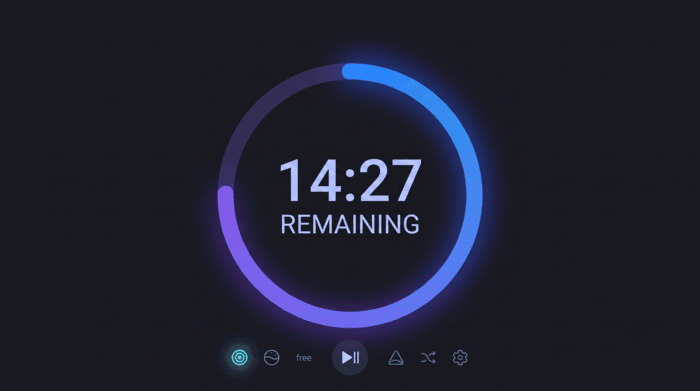
- Make time visible. In the 2024 employee study, trouble managing time was the executive function problem tied to physical fatigue. Days that silently overrun are draining in a way you do not notice until you crash. A visual timer that makes time visible shows how much of a block is left, so work stops expanding into your rest.
- Plan restorative breaks before you need them. When you are depleted, choosing a good break is one more decision you cannot make, so you default to scrolling. Build a pre-planned menu of restorative breaks on a better day. Our article on why pre-planned rewards work better than willpower explains the reasoning.
- Spend recovery time where you mask least. The Norwegian data showed masking dropped from 83% at school or work to 21% around neurodivergent peers. Where you can, spend your recovery hours with people and in places where you do not have to perform being organized.
- Get professional support. A therapist who works with adult ADHD can help you rebuild routines and untangle the shame that keeps the cycle going. Cognitive behavioral therapy (CBT) is one option with research behind it. A 2023 meta-analysis of 28 studies found that CBT for adults with ADHD reduced both core ADHD symptoms and emotional symptoms (Liu et al., Psychology and Psychotherapy, 2023). If you take ADHD medication, it is worth reviewing timing and coverage with your prescriber, especially if you notice it wearing off before your day ends.
How long this takes is the question everyone asks, and the honest answer is that nobody has measured it. No peer-reviewed study gives a recovery timeline for ADHD burnout. Some sources, including Google's own AI summary for this search, suggest pausing non-essential tasks for "2 to 4 weeks," but we could not find research behind that figure. The closest defined condition, autistic burnout, typically lasts three months or more. What reliably makes recovery longer is cutting demands only halfway, or jumping back into the catch-up stage the moment you feel a little better.
How to Stop the Next Burnout Before It Starts
Preventing the next crash comes down to two habits: noticing your early warning signs while you can still act on them, and keeping executive function load outside your head. Burnout rarely arrives without warning. Watch for your own early tells, the things that slip weeks before a crash. Common ones include sleep slipping, dropped routines like dishes or replying to messages, snapping at people, and dreading your inbox. Write yours down while you are recovering, when you still remember them clearly.
Then put a guardrail on the boom. After a good week, the pull is to take on more. A simple rule, such as not adding a new commitment until you have been on top of your current ones for two weeks, stops the overcommit stage before it starts.
Finally, match your supports to the kind of exhaustion you get. This map comes straight from the 2024 employee study's findings:
| If burnout feels mostly like... | Linked executive function problem | Practical lever | Free tool |
|---|---|---|---|
| Physical fatigue | Managing time | Make time visible, stop blocks overrunning | TimeBlind |
| Emotional exhaustion | Organizing and problem solving | Plan one visible step at a time | OneStep |
| Cognitive weariness (brain fog) | Organizing and problem solving | Offload open loops from working memory | BrainYap |
Links between burnout dimensions and executive function problems: Turjeman-Levi, Itzchakov & Engel-Yeger, 2024. Tool suggestions are practical aids, not treatments.
None of these tools require an account, which matters more than it sounds during burnout: a signup form is one more small demand you do not have to meet.
The Takeaway
- ADHD burnout is not a formal diagnosis, but the exhaustion behind it is real and documented.
- Research ties it to executive function strain (time management and organization) and to the effort of masking.
- It runs as a cycle, and the exit is cutting demands at the crash instead of catching up.
- Recover by subtracting load first, then adding outside supports for time and planning.
- If low mood persists for two weeks or more, or you have thoughts of harming yourself, get professional help.
Start small today: open TimeBlind for the next block of work, or build a break menu for tonight. When you have the energy, our guide to the full set of free ADHD focus tools maps every tool to the daily challenge it solves.
Frequently Asked Questions
How long does ADHD burnout last?
No published study gives a timeline for ADHD burnout, so be wary of any source that quotes a fixed number of weeks. How long it lasts depends mostly on how much load you can actually remove. The closest researched condition, autistic burnout, is described as typically lasting three months or more (Raymaker et al., Autism in Adulthood, 2020). If you have cut demands for several weeks and nothing is lifting, talk to a doctor, since that can point to depression or a medical cause.
Does ADHD medication help burnout?
ADHD medication treats ADHD symptoms, and some people find that makes daily compensation less draining. It does not treat exhaustion or depression directly, and there is no research showing it reverses burnout on its own. If burnout started after a dose or timing change, or your medication seems to wear off earlier than it used to, raise that with your prescriber rather than adjusting it yourself.
Is there a connection between ADHD and chronic fatigue syndrome?
There is an overlap. In a 2012 study of 158 adults with chronic fatigue syndrome, about 30% met criteria for ADHD in childhood and about 21% still had ADHD as adults (Sáez-Francàs et al., Psychiatry Research). That does not mean ADHD burnout and chronic fatigue syndrome are the same thing. Fatigue that does not improve with rest or reduced demands deserves a medical workup.
Is ADHD burnout a real diagnosis?
No. ADHD burnout is not in the DSM-5 or ICD-11. Even ordinary burnout is not classified as a medical condition: the World Health Organization lists it as an occupational phenomenon tied to chronic workplace stress. ADHD burnout is a descriptive term people and clinicians use for exhaustion that builds up from compensating for ADHD, and research on employees with ADHD shows the pattern behind it is real.
What is the difference between ADHD burnout and depression?
They can look alike and can happen together. Burnout usually eases when demands genuinely drop, for example during a light week or a real break, while depression tends to persist regardless and often includes losing interest in things you used to enjoy. If low mood lasts most days for two weeks or more, or you have thoughts of harming yourself, contact a doctor. In the US you can call or text 988 at any time.
What are the signs someone with ADHD is emotionally exhausted?
Common signs include a much shorter fuse than usual, stronger reactions to small criticism, dropping routines that used to run on autopilot, avoiding messages and small tasks, and a sense of dread about ordinary demands. In a 2025 study of 1,056 neurodivergent young adults, 94% named mental exhaustion as one of their challenges (Wurth et al., Frontiers in Psychiatry).
Take One Thing Off Your Plate Today
TimeBlind is free, private, and runs instantly in your browser. No signup, no email, no data leaving your device. Make the next block of time visible so today stops running over, and let one less thing live in your head.