Evidence-based guide · Published September 2026
ADHD and Autism: Differences, Overlap, and What It Means to Have Both
If you've read an ADHD symptom list and an autism symptom list and recognized yourself (or your child) in both, you're not imagining it. The two conditions are separate, they share a lot on the surface, and they show up together far more often than chance would predict. Here's how to tell them apart, what having both looks like, and why the overlap statistics you've seen don't match.
Skip the reading: try our 8 free ADHD tools, no signup →
Table of Contents +
🎯 Quick Summary (TL;DR)
- Two separate conditions: ADHD and autism are distinct DSM-5 diagnoses, and since 2013 a person can be diagnosed with both.
- Different cores: ADHD centers on regulating attention, activity, and impulses. Autism centers on social communication differences and restricted or repetitive patterns of behavior and interests.
- Lots of surface overlap: executive dysfunction, sensory sensitivity, emotional intensity, and deep focus show up in both, which is why they get confused.
- The overlap numbers vary a lot: published estimates of ADHD among autistic people run from about 28% to 70%, depending mainly on who was studied.
- This page is educational, not diagnostic. Only a clinician who evaluates for both can tell you which applies.
Is ADHD a Form of Autism? (Short Answer: No)
ADHD and autism are two separate neurodevelopmental conditions with separate diagnostic criteria. Having one does not mean you have the other, but they turn up together far more often than chance alone would predict.
The National Institute of Mental Health describes ADHD as an ongoing pattern of inattention, hyperactivity, and impulsivity that gets in the way of daily functioning. The CDC describes autism in terms of differences in social communication and interaction, plus restricted or repetitive behaviors and interests. Those are different starting points, even when the behavior they produce looks similar from the outside.
For a long time, the diagnostic rules made it impossible to have both on paper. A 2022 review in Frontiers in Psychiatry notes that the DSM-IV and ICD-10 treated the two diagnoses as mutually exclusive, while the DSM-5 "admits the possibility of comorbidity" (Hours, Recasens, and Baleyte, 2022). Our guide to ADD vs ADHD covers that 2013 rewrite in more detail.
ADHD is also the more common of the two. In 2024, an estimated 7 million US children aged 3 to 17, or 11.7%, had a current ADHD diagnosis (CDC). CDC autism surveillance for 2022 identified autism in 1 in 31 eight-year-olds, or 32.2 per 1,000, with boys identified 3.4 times as often as girls (Shaw et al., 2025, MMWR). The two figures come from different methods (a parent survey versus records review), so treat the comparison as rough, but the gap is large.
ADHD vs Autism: Side-by-Side Comparison
The fastest way to tell the two apart is to ask why a behavior happens, not just whether it happens. Avoiding a loud party, missing a social cue, or getting absorbed in one topic for hours can come from either condition, for very different reasons.
| ADHD | Autism | |
|---|---|---|
| Core difference | Regulating attention, activity level, and impulses | Social communication differences plus restricted or repetitive patterns |
| Attention | Drifts toward whatever is most stimulating; hard to hold on boring tasks | Often locked onto a chosen focus; hard to shift away from it |
| Routine and change | Craves novelty; routines feel dull and are hard to keep | Prefers sameness; unexpected change is distressing |
| Social interaction | Usually reads social cues but may interrupt, drift off, or miss details | Social cues and unwritten rules can be genuinely unclear or effortful to decode |
| Sensory experience | Often seeks stimulation; noise can distract more than it overwhelms | Often over or under sensitive to sound, light, texture, or smell |
| Intense interests | Hyperfocus that tends to rotate as novelty wears off | Deep interests that tend to be long lasting and highly detailed |
| Emotional regulation | Quick, intense reactions tied to impulsivity and frustration | Distress often tied to sensory overload, change, or social demands |
| "Avoids a loud party" because | Can't track the conversations, gets bored, or feels restless | The noise and social load are draining or overwhelming |
Summary of typical patterns drawn from the CDC, NIMH, and the American Psychiatric Association. Individual people vary widely, and many have traits from both columns.
Where ADHD and Autism Pull in Opposite Directions
The clearest split is how each condition relates to stimulation. The American Psychiatric Association puts it simply: a person with ADHD "may seek out constant stimulation and novelty," while a person with autism "may be easily overstimulated or sensitive to sensory input."
That one difference ripples outward. ADHD tends to push away from routine because repetition feels flat and hard to stick with. Autism tends to pull toward routine because predictability lowers stress. ADHD brains often turn up the input (music on, TV in the background, three tabs open) to stay engaged. Autistic brains more often turn it down (headphones, dim lights, one thing at a time) to stay regulated.
When both conditions are present, these pulls don't cancel out. They compete. That's the experience many people describe with a dual diagnosis, and it's why a routine that should help can feel impossible to build.
Having Both: What AuDHD Means
AuDHD is a community term, not a formal diagnosis, for a person who is both autistic and has ADHD. In clinical records it appears as two co-occurring diagnoses. The term caught on because the combination often feels different from either condition alone.
Common patterns people with both describe include:
- Wanting a fixed routine but lacking the executive function to set it up or keep it going.
- Getting bored by sameness and distressed by change, sometimes on the same day.
- Wanting social contact, then running out of social energy quickly.
- Deep, absorbing interests that still get interrupted by distractibility.
- One condition masking the other: ADHD impulsivity can hide autistic social differences, and autistic routines can hide ADHD disorganization.
Masking is one reason the second diagnosis often arrives late. A population study of schoolchildren in Spain found that only 16% of children who met criteria for both had previously been diagnosed with both (Canals et al., 2024, Autism Research). Late recognition is common for ADHD alone, too: among the estimated 15.5 million US adults with a current ADHD diagnosis in late 2023, 55.9% were diagnosed in adulthood (Staley et al., 2024, MMWR). That figure covers ADHD generally, not people who are also autistic, but it shows how often an adult diagnosis follows years of unexplained struggle.
Women and girls face an extra layer of delay, since both conditions are independently underdiagnosed in them. Our guide to ADHD symptoms in women explains why both are missed in women so often.
How Often Do ADHD and Autism Occur Together? Why the Numbers Disagree
They overlap often, but how often depends on who was studied. Published estimates of ADHD among autistic people run from about 28% to 70%. Autism among people with ADHD is lower, roughly 10% to 21%. If you've seen "50 to 70%" quoted as the answer, that's the top of the range, not the consensus.
Sources: Lai et al., Lancet Psychiatry, 2019; Canals et al., Autism Research, 2024; Rong et al., Research in Autism Spectrum Disorders, 2021 (current prevalence); Hours et al., Frontiers in Psychiatry, 2022; Martinez et al., Frontiers in Psychiatry, 2024; Hollingdale et al., Psychological Medicine, 2019. Figures are not directly comparable: samples, ages, and diagnostic methods differ.
Clinic samples run higher than population samples. A Lancet Psychiatry meta-analysis put co-occurring ADHD at 28% of autistic people and found that "estimates in clinical sample-based studies were higher than in population-based and registry-based studies" (Lai et al., 2019). People who end up in specialist clinics tend to have more complex needs, so a study that recruits from a clinic will find more overlap than one that screens a whole school.
Age and diagnostic criteria change the answer. A meta-analysis of 63 studies found pooled ADHD rates of 38.5% (current) and 40.2% (lifetime) among autistic people, and reported that age, intellectual disability, recruitment setting, and diagnostic criteria all significantly influenced the result (Rong et al., 2021). The Spanish school study showed the age effect directly: 33% of autistic children also had ADHD overall, but the rate was 46% among older children and 22% among younger ones (Canals et al., 2024).
Single studies swing widely. The 2022 Frontiers in Psychiatry review that cites "50 to 70%" also notes that reported rates across individual studies range from 10% to 90% (Hours et al., 2022, cited above). Pooled meta-analyses smooth out those extremes, which is why they land lower.
The direction matters. Because ADHD is so much more common than autism, the share of people with ADHD who are also autistic is smaller. A meta-analysis of 22 publications covering 61,985 children and adolescents found that 21% of those with ADHD met criteria for autism, with no significant difference between community (19%) and clinical (24%) samples (Hollingdale et al., 2019). Mixing up the two directions is an easy mistake, and some summaries of this research do exactly that.
The practical takeaway: if you or your child has one diagnosis, the chance of the other is high enough that it's worth asking about, whichever study you trust.
Getting Evaluated and Getting Support
Ask for an evaluation that screens for both conditions. An assessment built around a single checklist is one of the most common reasons the second diagnosis gets missed, especially when one condition masks the other.
For children, the CDC lists developmental-behavioral pediatricians, neurodevelopmental pediatricians, and child neurologists among the specialists who diagnose autism. For adults, psychiatrists and clinical psychologists typically assess both conditions, and some neuropsychologists specialize in adult evaluations. When you book, say directly that you want both considered. If you're an adult woman going through this, our guide to what the ADHD assessment process looks like walks through each step, and our overview of the three types of ADHD explains the presentations a clinician will be choosing between.
Support is individualized. It often combines ADHD treatment (which may include medication), therapy or coaching, and changes to the environment such as predictable routines, lower sensory load, and clear written plans. If medication is part of the plan, tell the prescriber about both diagnoses, since that can affect how a medication is chosen and adjusted. This article is educational and is not a diagnostic tool.
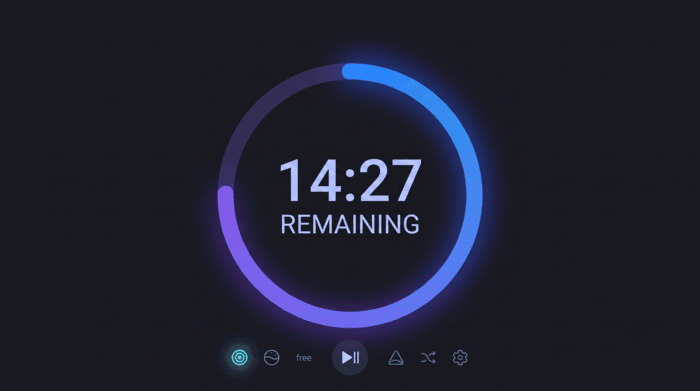
Day to day, the shared struggles respond to the same kind of practical scaffolding regardless of label. Breaking a task into one visible step at a time with OneStep helps with starting. A visual countdown like TimeBlind makes transitions predictable instead of sudden. Neither replaces clinical care, but both lower daily friction. Our guide to free tools for executive dysfunction covers the rest.
The Takeaway
- ADHD and autism are separate diagnoses, and since the DSM-5 in 2013 a person can have both.
- They share executive dysfunction, sensory differences, emotional intensity, and deep focus, which is why they're easy to confuse.
- The clearest difference is stimulation: ADHD tends to seek it, autism tends to be overwhelmed by it.
- Overlap estimates range from about 28% to 70% of autistic people having ADHD, depending mainly on who was studied.
- If one diagnosis is on the table, ask for an evaluation that covers both.
From here, learn how inattentive ADHD gets mistaken for other conditions, or try a free tool from the ADHD toolkit.
Frequently Asked Questions
Can you have ADHD and autism at the same time?
Yes. Older diagnostic manuals (DSM-IV and ICD-10) treated the two as mutually exclusive, but the DSM-5, published in 2013, allows both to be diagnosed in the same person (Hours, Recasens, and Baleyte, Frontiers in Psychiatry, 2022). Co-occurrence is common: a Lancet Psychiatry meta-analysis estimated that 28% of autistic people also have ADHD (Lai et al., 2019), and other studies report higher figures depending on who was sampled.
What do ADHD and autism look like together?
People with both often describe a push and pull: autism draws them toward routine, predictability, and lower sensory input, while ADHD pulls toward novelty and stimulation. The American Psychiatric Association describes ADHD as seeking constant stimulation and novelty, and autism as being easily overstimulated. In daily life that can look like wanting a fixed routine but struggling to build or keep one, or wanting social contact but running out of energy for it quickly.
Is ADHD a type of autism?
No. ADHD and autism spectrum disorder are separate diagnoses in the DSM-5, and having one does not mean a person has the other. They do frequently co-occur: a 2024 review in Frontiers in Psychiatry found that roughly 13% of children diagnosed with ADHD are eventually also diagnosed with autism, while comorbid ADHD in children with autism ranges from about 40% to 70% depending on the study (Martinez, Stoyanov, and Carcache, 2024). Only a qualified clinician can sort out which conditions are actually present.
How are ADHD and autism treated when someone has both?
There is no single treatment for the combination. Care is built around the individual and often mixes ADHD treatment (which can include medication), therapy, skills support, and changes to the environment such as predictable routines and lower sensory load. If medication is part of the plan, make sure the prescriber knows about both diagnoses, since that can change how a medication is chosen and adjusted.
Who can diagnose ADHD and autism?
For children, the CDC lists developmental-behavioral pediatricians, neurodevelopmental pediatricians, and child neurologists among the specialists who diagnose autism. For adults, psychiatrists and clinical psychologists typically assess both conditions, and some neuropsychologists specialize in adult evaluations. When you book, ask specifically for an evaluation that screens for both conditions. A process built around only one checklist is a common reason the second diagnosis gets missed.
Whatever the Label, Start With the Friction You Feel Today
ZeroLoginFocus is free, private, and works instantly in your browser. No signup, no email, no data leaving your device. Pick the tool that matches the part of the day that costs you the most.